https://www.youtube.com/watch?v=fobN_XSOQ5s
Summary
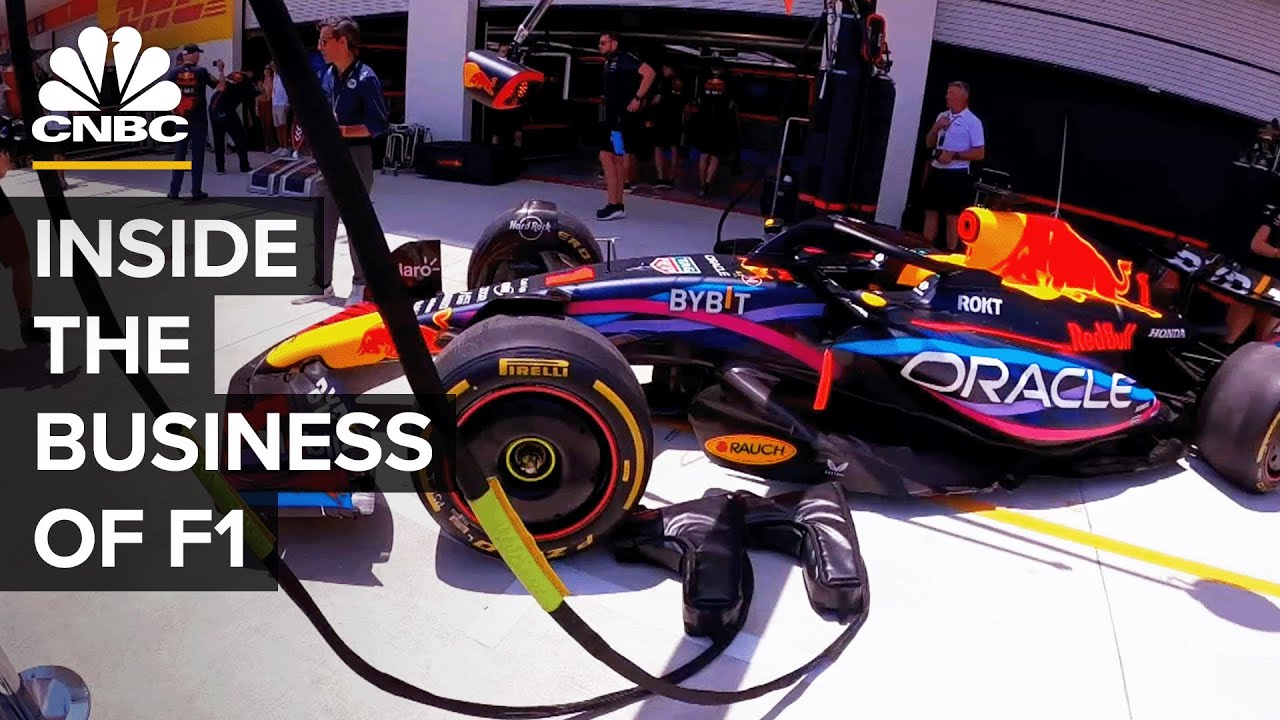
This CNBC video explores the complex and lucrative business model of Formula 1 (F1), the world's most elite racing league, which has doubled in value to an enterprise value of approximately $16 billion since being acquired by Liberty Media in 2017.
The Business of Speed: F1 is described as a "prototype business" where standing still means going backward. Teams like Mercedes, Red Bull, and McLaren are not just sports teams but high-tech businesses. Team Principals like Toto Wolff (Mercedes) and Christian Horner (Red Bull) act as CEOs, managing hundreds of millions of dollars in operations, from R&D to sponsorship deals.
Revenue Streams:
Sponsorships: A critical income source. For example, Haas F1 partnered with MoneyGram because F1's global reach (20+ countries) overlaps with 70% of MoneyGram's transaction revenue, targeting a younger demographic.
Prize Money: Distributed based on performance (Constructors' Championship standing) and historical significance (e.g., Ferrari gets a bonus for its long history).
Brand Marketing: For manufacturers like Mercedes and Red Bull, F1 serves as a massive global marketing platform. Red Bull uses F1 to promote its energy drinks to a global audience, which is more cost effective than traditional advertising for the same level of exposure.
Financial Sustainability & Cost Cap: A major turning point for F1 was the introduction of the Cost Cap (limited to $135 million in 2023). Before this, top teams spent up to $500 million annually, making it impossible for smaller teams to compete. The cap has:
Leveled the playing field: Preventing top teams from simply "buying" speed through endless R&D.
Ensured profitability: Turning teams from money losing ventures into sustainable, profitable franchises, similar to American sports leagues (NFL, NBA).
Future Growth: The sport is experiencing a "golden moment," especially in the US, driven by a younger audience and the "Netflix effect" (Drive to Survive). Team valuations are soaring, with even smaller teams like Alpine being valued at over $900 million.
Discussions
1. The Impact of the Cost Cap The video highlights that the cost cap (budget limit) has made F1 teams profitable and leveled the playing field. However, some argue it stifles innovation because engineers can't freely develop new technologies. Do you think strict financial regulations in sports improve the competition by making it fairer, or do they harm the spirit of excellence by artificially limiting what top teams can achieve?
2. F1 as a Marketing Platform Red Bull is an energy drink company, yet it runs one of the most dominant F1 teams in history. Discuss how F1 functions as a marketing tool versus a sport. Does the heavy commercialization (e.g., naming rights like "MoneyGram Haas F1 Team") dilute the identity of the teams, or is it a necessary evolution for modern sports survival?
3. The "Americanization" of F1 Since Liberty Media (a US company) bought F1, the sport has seen American style changes like the cost cap, a focus on entertainment (Netflix), and more races in the US (Miami, Vegas). Do you think this "Americanization" has saved the sport from financial ruin, or is it risking alienating the traditional European fanbase by prioritizing show business over pure racing?
4. Profitability vs. Passion Toto Wolff mentions that "if we win, financial success is going to follow," prioritizing performance. However, for smaller teams, mere survival and profitability are often the main goals. In a high stakes environment like F1, should the primary measure of a team's success be trophies or financial balance sheets? Can a team truly be successful if it makes a profit but never wins?
5. The Future of Global Sports Business F1 has successfully captured a younger, global demographic (Gen Z) that many traditional sports are losing. What specific lessons (e.g., behind-the scenes content, tech focus, global expansion) can other struggling traditional sports or industries learn from F1's recent business turnaround?
'영어 모임 주제' 카테고리의 다른 글
| 산본 영어 모임 12월 주제 25년 마무리 & 26년 계획 Sanbon English Lab (0) | 2025.12.26 |
|---|---|
| 산본 영어 모임 12월 주제 Relationship Debate Questions (0) | 2025.12.15 |
| Sanbon English Lab 11월 주제 미세 플라스틱 (0) | 2025.11.12 |
| Sanbon English Lab 11월 주제 Zucman Tax 프랑스 부유세 (0) | 2025.11.02 |
| Sanbon English Lab 10월 주제 기축통화 달러의 시대는 끝이 났을까? (0) | 2025.10.20 |