https://www.youtube.com/watch?v=CAm0hA_D5J0
This video features researcher Helen Fisher, who studies the brain in love and relationships. Her talk explains the biology behind why we fall in love and who we are attracted to.
Here are the key takeaways:
- Love as a Brain System: Fisher argues that romantic love is a powerful and universal brain system, a fundamental mating drive that can be likened to an addiction. It can also temporarily suppress parts of the brain responsible for judgment.
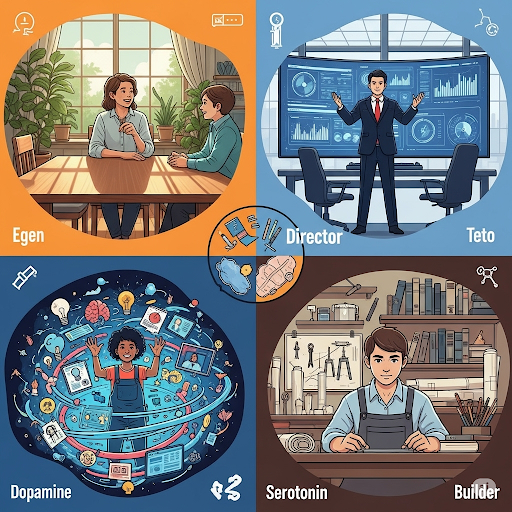
- Four Biological Personality Styles: She proposes four broad personality types linked to different neurochemicals:
- Dopamine (Explorer): Creative, curious, and sensation-seeking.
- Serotonin (Builder): Calm, cautious, and conventional, valuing rules and loyalty.
- Testosterone (Director): Analytical, decisive, and emotionally contained, good at rule-based systems.
- Estrogen (Negotiator): Intuitive, imaginative, nurturing, and emotionally expressive, seeing the big picture.
- Attraction Patterns: Fisher suggests that certain types are naturally attracted to each other: Explorers tend to be drawn to other Explorers, and Builders to other Builders. However, Directors (Testosterone) are often attracted to Negotiators (Estrogen), and vice versa.
- A Tool for Better Relationships: Fisher concludes that understanding these biological personality styles can be a powerful tool for building happier and more fulfilling relationships, both in personal life and in professional settings.
한국에는 에겐형 테토형 위주로만 알려있지만 원래는 2가지가 추가로 더있습니다. 질문 읽으시기전에 본인이 에겐형,테토형,도파민형,세로토닌형인지 태스트 해보시면 좋을꺼 같습니다:
https://openpsychometrics.org/tests/FTI/1.php
1. Fisher's model suggests that some types are attracted to each other. Do you agree with her findings that opposites attract (like Directors and Negotiators) while similar types also attract (like Explorers and Builders)? Can you think of examples from your own life, movies, or history that support or challenge this idea?
2. Fisher's model focuses on the biological roots of personality. To what extent do you think our personality and romantic choices are determined by our neurochemistry (like dopamine and testosterone), versus our life experiences and cultural upbringing? Which factor do you believe is more influential in modern society?
3. Fisher suggests that understanding these biological types can help us build better relationships. How can this knowledge be used practically, both in romantic partnerships and in professional teams? What are the potential downsides of categorizing people this way?
'영어 모임 주제' 카테고리의 다른 글
| Sanbon English Lab 10월 주제 Nepal Gen Z revolt 네팔 젠지 혁명 (1) | 2025.09.24 |
|---|---|
| Sanbon English Lab 9월 주제 Gaza War 이스라엘-팔레스타인 1편 (0) | 2025.09.15 |
| Sanbon English Lab 8월 주제 미국 러시아 우크라이나 3자 회담? 우크라이나-러시아 전쟁 근황 (0) | 2025.08.20 |
| Sanbon English Lab 8월 3주차 모임 주제 바이오컴퓨팅 Biocomputing (0) | 2025.08.03 |
| Sanbon English Lab 8월 첫번째 모임 주제 "데이터 센터의 딜레마: 디지털 발전인가, 환경 부담인가? (0) | 2025.08.03 |